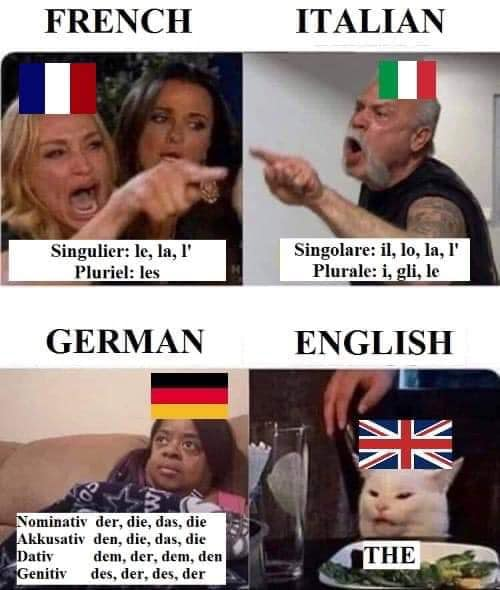

Slavic languages: You guys have articles?
Finnic as well
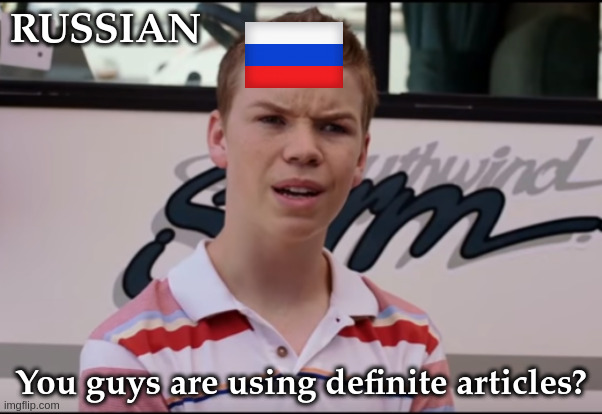
Japanese: you guys have plurals?
Japanese: just say the word twice.
Any slavic language afaik.
deleted by creator
Damn, beat me to it!
I was gonna say that for Chinese but I ain’t got a nice gif like that.
Also no plural.
What really fucks with me is akkusativ suffixes
If dein grampa isn’t the first and foremost noun in a sentence then it has to be deinen grampa but if it’s a feminine word the the rule doesn’t matter
Meine Oma Liebt deine Oma.
Mein Opa Liebt deine Oma.
Mein Opa Liebt deinen Opa.
Meine Oma Liebt deinen Opa.
I want to be good at this but that shit makes no sense, Hans. And why the fuck does a Library have a gender?!
EDIT: Liebt not Liebst in this context
Just a minor correction: instead of “Liebst” it must be “liebt” since it’s 3rd person singular:
- ich liebe
- du liebst
- er/sie/es liebt
Thank you for catching that, I appreciate the input.
Because the subject is in Nominativ and the object is in Akusativ here.
Has anybody so far just considered not doing any of that anymore?
No? Because then the whole langiage just stops functioning. I will just assume your native langiage is english here because pretty much all other european languages have cases.
I don’t think it would stop functioning if everything was das and dein, though. Bonus points for making every verb end with e as if it followed ich.
Don’t worry, Dativ will come and double fuck you too
Note that “liebt” should not be capitalized here because it’s a verb.
Oh yeah I forgot German uses capitalization for uses other than emphasis or punctuation. In English, they don’t change capitalization based on context of subject/verb.
I fucking love German grammar!!! It’s awesome. The Futur 2 and Plusquamperfekt are my favourite. We have some funky letters like ß (<- look at this guy :) ) and weird sounds like the CH and SCH. There is this one grammar “rule” that I don’t like. Because there is no real rule. You just have to know. It’s about the “connecting s”. So in some compound words you sometimes put an s between the two words to connect them. But there is not really a way to know when to do it. It’s Rind + Fleisch = Rindlfeisch but Rind + Leder = Rindsleder with an S.
Thank you all for coming to my tedtalk.
I love how we can stick two words together and bam it’s a new word. Rucksackriemenquerverbindunsgträger
Compound words are great because there’s no ambiguity about where noun groups start and end. English has compound words too, but german are the undisputed champions of compound words.
That’s why “the” is such a common word in English. If you have a toddler, teach them to read (recognize) the word “the.” Then sit down together with a book, reading aloud with your finger running under the words, and pausing to let them read all the "the"s. It’ll help them get the connection between print and speech, even if they’re still working on the alphabet. And they’ll feel powerful.
As a lesson in English, you can explain that even though there’s no t, h, or e sound in it, it’s pronounced “the” because whenever t and h are together we say (long exaggerated th sound), and it’s such an old and common word that we got lazy about saying “ee” and now we just say “uh.”
I taught my daughter to read during covid when the schools were closed. ‘The’ was the first word she learned to read, and I did exactly what you suggest, pausing for her to read it. It really helped. When my workshop reopened I made her a silver badge of the word ‘the’ to celebrate.
In Persian we don’t even have “the”. If it’s indefinite we use the equivalent of “a”. If it’s definite we don’t use anything.
Also English: Random pronunciation without working rules.
Blame the Norman French.
nooo Why did the Norman-French army of William, Duke of Normandy, have to Invade in 1066? It could have been so much simpler …
A lot more Germanic, anyway. We’d have a lot more in common with our cousin tongues.
Also include Gaelic languages like Irish and Scottish influencing English. I remember making a Portuguese colleague pronounce the words “bough”, “lough” and “tough”. It was funny and a realisation that the English language is just as non-sensical as any languages. Millennia of language mixing made any attempts to make sense of any language rules farcical but in amusing way.
This really fucked me up in German class
Meanwhile Danish turns the indefinite article into a definite suffix. Like:
A house: “et hus”
The house: “huset”
Houses: “huse”
The houses: “husene”Don’t most (if not all) Nordic languages do that?
Also, I can’t help but share: https://youtu.be/s-mOy8VUEBk
Scandinavian, yes, nordic, well, I don’t think they do it in Finnish? Not sure about Icelandic.
Fair. I meant Scandinavian and not Finno-Scandic in my comment. Finnish isn’t even in the same language family, so I don’t claim to know anything about it
English can be confusing too-- just look how many homophones we have! https://www.youtube.com/watch?v=CNTM9iM1eVw
What did you call me?
Which psychopath decided to put the cases in German in the wrong order?
It’s:
- Fall (Nominativ)
- Fall (Genitiv)
- Fall (Dativ)
- Fall (Akkusativ)
German:
Singular: der, die, das
Plural: die
Und jetzt machen wir die unbestimmten Artikel.
Und den Plural auch nicht jeweils vergessen
Singular male, female, neuter, Plural male, female, neuter
Nominative: ο, η, το, οι, οι, τα
Genitive: του, της, του, των, των, των
Accusative: τον, την, το, τους, τις, τα
Callitive: (no article)
dual plural is ripe for a comeback
deleted by creator