Fight decades of misinformation on China with official Chinese sources.
- 51 Posts
- 118 Comments

 10·2 years ago
lemmygrad.ml is working fine, hexbear.net and lemmy.ml are partially blocked. Side note: prolewiki.org is also partially blocked.
When I say partially blocked, it means that the IP addresses aren’t blocked, so I can still connect to them without a VPN by doing some HTTP trickery with a custom Firefox extension. Fully blocked means the IP addresses are blocked so you must use proxies like VPN/IPFS/Tor to connect.
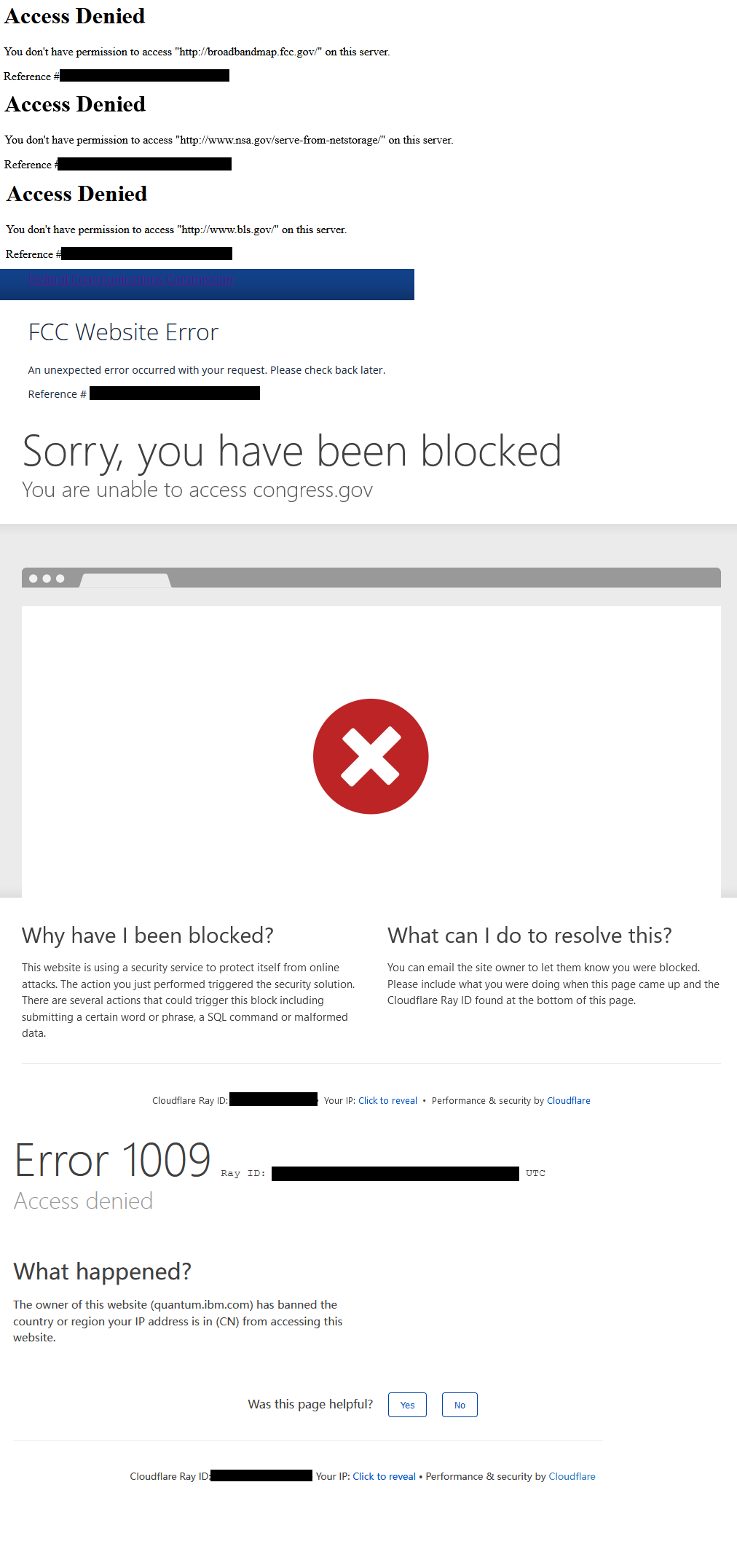
In other news, here’s a list of US government sites (and one IBM subdomain) I encountered that blocks Chinese IPs:
 9·2 years ago
I’m not sure who you were, but I took over !china@lemmygrad.ml while you were away: https://lemmygrad.ml/post/3309739, welcome back!
 5·2 years ago
Didn’t watch the video, here’s my opinion of standardized testing:
Standardized tests provides two results, individual performance and group ranking. Besides academic tests seen mainly in school, other forms of tests like sports competitions are also standardized tests.
China’s Gaokao is very competitive due to scale (population) and limited resources (spots in universities).
- Scale
In 2023, there were 12.91 million Gaokao applicants, but the total enrollment number for regular undergraduates was just 4.7816 million in total across 1242 regular undergraduate schools. (Source: http://www.moe.gov.cn/fbh/live/2024/55831/sfcl/202403/t20240301_1117517.html) An enrollment ratio of 1 in 3 applicants seems fine until you realize that most people want to get into a good university, not get into any university.
Looking at the total number of applicants nationwide isn’t enough, because enrollment through Gaokao is by province. The number of applicants by province vary widely across China, from as low as 58 thousand in Beijing, 54 thousand in Shanghai, 33 thousand in Xizang, to as high as 1.3 million in Henan, 800.73 thousand in Sichuan. The number of people who actually took the test is lesser than the number of applicants, but that’s basically the scale we’re looking at.
- Limited resources
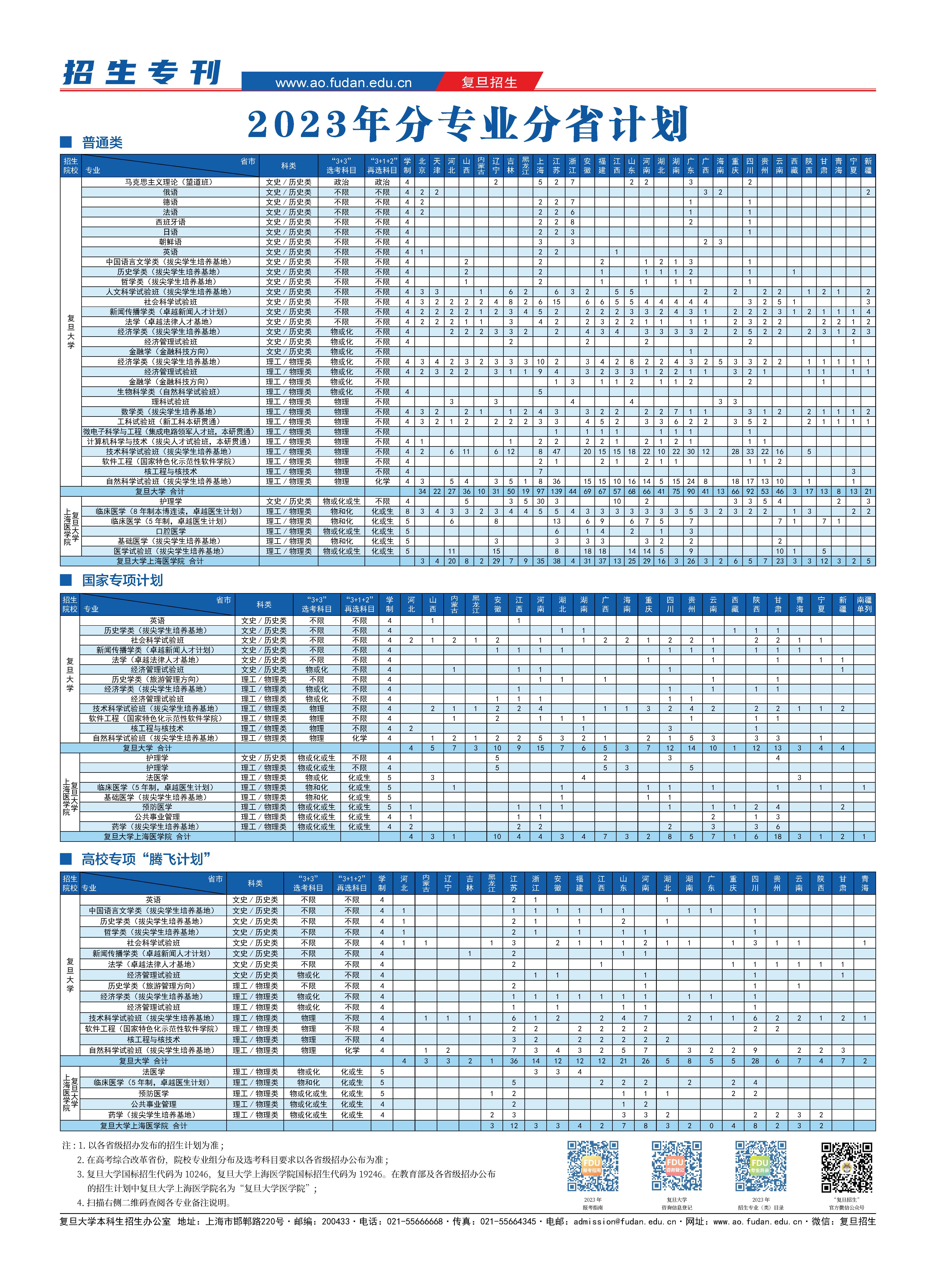
I’m going to look at Fudan University’s 2023 enrollment plan because it is Shanghai’s prestigious university and its enrollment website provides a handy table of figures by province: https://ao.fudan.edu.cn/af/c9/c36332a634825/page.htm, full-scale image: https://ao.fudan.edu.cn/_upload/article/images/57/f3/952bd7fd46a5a8df948d0c31dc97/d1a91020-e1c2-48ba-a27e-7b851495e4c8_d.jpg. As a university based in Shanghai, Fudan enrolled 97 students from Shanghai (54 thousand Gaokao applicants), 139 from Jiangsu (neighboring province with 445 thousand Gaokao applicants), 66 from Henan (province with most Gaokao applicants at 1.3 million). The ratio of Gaokao applicants to enrollment number in each province thus varies a lot, 557 for Shanghai, 3201 for Jiangsu, 19697 for Henan.
Although this is just one simplistic case study, you can see how this selection process can be unfair to students from different provinces.
Gaokao is mainly for students who went to regular high schools, as opposed to students who went to vocational schools, there are about half as many students in secondary vocational education (12.9846 million) as there are students in regular high schools (28.0363 million). Though Gaokao is the most common way to get into university, it is not the only way.
I’ve mentioned that Gaokao can be unfair due to scale and limited resources, it is also unfair to those who do not excel at this type of testing, but now I want to talk about selection in general. A holistic approach to selecting people would be interviewing and investigating each candidate, but this does not scale well, though with AI tools this type of selection is already happening in some workplaces (with questionable reliability).
I think the questions to ask are: What exactly are universities selecting students for? Is it to maximize profit from student tuition? Is it to increase quantity and quality of research output? Is it to provide better candidates for the job market? Is it to nurture talents for strategic national interests? Looking at it from a wider angle, when we talk about developing the productive forces for socialism, what kind of expertise and industries should the state prioritize? If certain areas are prioritized over others, overabundance may be an issue, which is one critic of planned economy, but we also know that market economy is not absent of overabundance.
Going back to the topic of Gaokao, it is highly regarded and stressful to all involved (students, teachers, parents, schools, society), there are definitely problems with the current system. But any reforms to college admission would most likely still require open and transparent standardized testing, as opposed to setting various arbitrary or ambiguous criteria that are more susceptible to underhanded practices.
This exact topic was brought up 2 months ago here: https://lemmygrad.ml/post/3242674
My comment chain: https://lemmygrad.ml/comment/3384450
 3·2 years ago
the professor explains that a party reportly bluntly states that development in china has been rather uneven, unbalanced and lopsided. There are significant issues with party loyalty and corruption. Gaps between rural and urban areas are large. Many cadres don’t promote scientific innovation well and so on. It might not be correct to pin all of this on rightist errors by one man, but these are errors.
Maybe you could further explain how uneven development or any of the other issues are “rightist errors”, there is a fundamental divide between people who outright reject Deng Xiaoping’s policies and those who accept them with criticism. The policy of 一国两制 (One China, Two Systems) is probably the most suitable example that can be viewed as “rightist”, letting Hong Kong and Macao continue to operate their capitalist system. Other less “egregious” examples are 经济特区 (Special Economic Zones) like Shenzhen and Hainan, there’s also the “infamous” 社会主义市场经济 (socialist market economy).
once a country has been made independent of imperialists, nationalism becomes an obstacle to socialist development
China’s policy of peaceful coexistence would be helped by promoting a more internationalist stance in culture.
From Mao era’s 世界人民大团结万岁 (Long live the great unity of the people of the world) to Xi era’s 人类命运共同体 (community of shared future for mankind), China has always been advocating for internationalism.
Nationalism’s call to unity is collectivism at the national-level, I agree that collectivism at different levels can be in conflict with each other, for example when family interests conflict with national interests. There is a Chinese saying “舍小家、为大家”, which means something like “for the greater good”, to describe putting the interests of the greater collective (nation) before the smaller collective (family/self).
Similarly, national interests and international interests can also be conflicting, but China doesn’t choose nationalism or internationalism exclusively, it depends on the situation. When assisting the development of Global South countries, is that not internationalism at work? When handling disputes in the South China Sea, China defends its legitimate claims to the islands for national interests.
Nationalism can be reactionary when used at the expense of other nations (invasion, chauvinism, xenophobia), internationalism can be reactionary when used in disregard of legitimate national interests (like contributing to underdevelopment of the current nation, sounds familiar? That’s what some people say when China provides cheap goods at the detriment of Chinese workers). Until world communism has been achieved, there’s no simple “choice” between nationalism or internationalism, even then there will be new problems in the new world order.
China before Xi’s reforms was pretty much a capitalist hellhole. Corruption, environmental degradation and poverty were rampant
Those issues do not justify calling China during that period a “capitalist hellhole”.
even the CPC’s official stance is that Deng made some rightist errors
Could you provide the source for this?
The CPC has also made errors in recent years by becoming more nationalistic and has moved slower on LGBTQ rights than is expected of a socialist country.
China’s nationalism is controversial to some, probably because they think it’s like the toxic “America First”, or that it is not a very communist stance, but I do not see it as a mistake. Nationalism is fundamental for the survival of any nation that wishes to be independent and not controlled or invaded by foreign powers.
LGBTQ rights are important in the sense that they are treated as normal people, not “special” people. China is certainly lacking some LGBTQ rights that are available in other countries like same-sex marriage.
In Shanghai, you can usually get around using public transportation (bus, subway, ferry), shared bicycles (electric and non-electric), or electric scooters, these are the cheaper options. The more expensive options are using ride-hailing apps, taxi services, or driving your own car.
There are areas outside the main city area of Shanghai that resemble “suburbs” or what we call “城乡结合部”, large patches of residential areas that consist of mostly one to three-story tall houses, some of the areas haven’t been covered by the subway system yet. Here you can still get around using buses, electric scooters, bicycles (if the distance is short or you really want to). There are still office buildings, malls, commercial streets in these “suburbs”.
China’s high-speed rail have train numbers with D/G prefix, but there are still normal-speed trains with T/K/Z prefix (or even no prefix) for intercity travel.
As for traffic jams caused by cars, this is not a problem unique to any political system, it is a city-planning and engineering problem.
My opinion of cars is while they are convenient for family/group travel and carrying baggage, they take up too much space on the road and require lots of dedicated parking space. Maybe they should be designed differently in future.
Thanks, I was deciding between factoid or trivia, now I changed it to facts.
Related news:
Seafood from inland Xinjiang becomes new love for foodies in China https://news.cgtn.com/news/2023-10-07/Seafood-from-inland-Xinjiang-becomes-new-love-for-foodies-in-China-1nEDg2FZPSU/index.html
Inland aquaculture swimming in demand https://www.chinadaily.com.cn/a/202310/10/WS6524a5a1a31090682a5e7a63.html
While the video looks fine, I find the lack of text or background info in the description very concerning, and the situation seems to extend to their other videos. Also what’s up with the channel using Wonder Woman’s crest as their logo, I know they’re called “Top Wonder” but that’s just weird, I wonder if anyway is suing them.
Yeah the questions were translated and the original data in Mandarin is not publicly available, from the study:
Data availability statement
A sample of the questionnaire. translated into English, is available in supplementary information at npj: Science of Food’s website. The completed 2063 questionnaires and the resulting database for the statistical analyses are in mandarin are not publicly available but can be made available from the corresponding author on reasonable request.
The usage of 爱国者 (patriot) is probably not as common as 爱国 (patriotic), 爱国主义 (patriotism), or even 小粉红 (pinky/pinko, both a derogatory term to refer to Chinese patriots/nationalists, but also normalized by patriots to use to call themselves, kind of like the n-word for African Americans). The Chinese tech brand aigo is literally 爱国者 (patriot) in Chinese. Mentions of US “Patriot” missiles in the news are also instances where you can find 爱国者 (patriot).
As for surveys themselves, I can’t speak for whether it is accurate to paint a representation of any large population with a sample size of less than 0.00015% or 1 in 666,667 of the population, even if it’s claimed to be statistically relevant. In this case this particular question about US bioterrorism was constructed in such a loaded way that the results shouldn’t be taken seriously.
Also the option “Disagree, debate on GM food should base on science” also feeds into Chinese liberals’ talking point that Chinese patriots favor patriotism over science, as if those two are mutually exclusive.
Besides the Chinese person mentioned in the article (彭光谦, Peng Guangqian, Baidu wiki includes the GMO controversy: https://baike.baidu.com/item/彭光谦/8993457) there was also this person called 崔永元 (Cui Yongyuan, Baidu wiki: https://baike.baidu.com/item/崔永元/324929) who was a famous CCTV show host, and he was anti-GMO.
China’s Ministry of Agriculture and Rural Affairs responded to Peng Guangqian’s questions about transgenic technology in this 2013 article (http://www.moa.gov.cn/ztzl/zjyqwgz/sjzx/201310/t20131018_3634054.htm), and created this special page for info related to transgenic technology (http://www.moa.gov.cn/ztzl/zjyqwgz/) that is still updated to this day.
Even though it may be interesting to some, but I think finding out how many people in China believe “the US is carrying out bioterrorism against China via GM food” is not a worthwhile thing to do, compared to the more important question of how to carry out research regarding transgenic technology safely and scientifically. I personally think transgenic tech is inherently a complicated topic so I’m neutral about it.
There are other theories regarding US bioterrorism like whether the US caused covid-19, no matter if it was intentional or by accident, now that theory has more support and is indirectly encouraged by the Chinese government. For example, from this Chinese Foreign Ministry Regular Press Conference transcript on 2021-08-27: http://ipc.fmprc.gov.cn/eng/fyrth/202108/t20210827_9130747.htm
The US side said they need “reasons” to support an investigation in the US. Then, please answer the following questions. First, patients of the EVALI outbreak in July 2019 in Wisconsin in the US had symptoms highly similar to that of COVID-19. Isn’t this a reason? Second, according to the US NIH website, research has shown that evidence of infection in five states appeared back in December 2019. Isn’t this a reason? Third, the US government sealed blood samples collected before January 2, 2020 from further testing on the ground that it interferes with the origins tracing agenda and is detrimental to US national security. Isn’t this a reason? Fourth, Florida Department of Health once removed data from its website that showed 171 patients had coronavirus symptoms or positive test results in January and February, 2020. Isn’t this a reason? Fifth, many comments on social media like Facebook indicate that more than 200 people in the US or countries having close ties with the US said publicly people they know or they themselves had suspected infection of the novel coronavirus as early as in November 2019, with COVID-like symptoms. Isn’t this a reason? Sixth, 12 countries including Costa Rica and Kenya publicly said that their “patient zero” of COVID-19 came from the US. Isn’t this a reason? Seventh, Fort Detrick and the University of North Carolina (UNC) have a dark chapter in history and poor safety records of coronavirus researches. The US Army Medical Research Institute of Infectious Diseases, which is based in Fort Detrick, was shut down by the US CDC because of serious safety incidents in the fall of 2019, before the outbreak of COVID-19. Isn’t this a reason?
Given that the US is confident that it has nothing to hide, then it should face up to the questions of the international community by inviting the WHO to do the origins study in Fort Detrick and the UNC, and release the raw data on early cases in the US. Should the US refuse to cooperate, it would only further expose its true intention of politicizing origins study.
Thanks to @yogthos@lemmygrad.ml for the ping. Let’s look at the study linked by the article: Public perception of genetically-modified (GM) food: A Nationwide Chinese Consumer Study https://www.nature.com/articles/s41538-018-0018-4
There has been a general lack of fundamental studies on the public’s scientific perception and policy interpretation of GM food. Moreover, the scope of previous surveys has been limited to a few of the largest cities in developed areas of China, with little or no coverage of rural areas. In all cases, the number of respondents in most of these earlier surveys was less than 1000. This study summarizes the status of GM food in China and provides the results of questionnaires that surveyed consumers from every province on their knowledge level, present attitudes, and future thoughts of GM food in China. A statistically relevant sample size of 2063 questionnaires were satisfactorily completed.
The reasons given by consumers in favor of, or against, the use of GM food, were complex, as seen by the response of 13.8% of respondents who felt GM technology was a form of bioterrorism targeted at China.
I’m not going to question what is “statistically relevant”, but I think it’s insane for Alliance for Science to extrapolate 13.8% of 2063 people to all 1.4 billion people in China (regardless of age or background) to get 190 million.
If we look at the results for the question:
There is an opinion that the transgenic technology from the US maybe the bioterrorism to China. If you are a patriot, you should oppose GM food. What do you think about this?
- 13.8% Agree, patriot should oppose GM food
- 54.4% Disagree, debate on GM food should base on science
- 31.8% I have no idea about that
The option wasn’t “I agree that GM tech is US bioterrorism against China”, it was “The question is presenting an opinion that suggests Chinese patriots should oppose GM food because they are part of US bioterrorism against China, I agree”. What a twisted way to conduct a survey.
From today’s (Jan 31) Chinese Foreign Ministry Regular Press Conference: https://www.mfa.gov.cn/eng/xwfw_665399/s2510_665401/202401/t20240131_11237282.html
AFP: It’s reported that the Chinese President yesterday in Beijing received credentials of ambassadors from many countries, including Afghanistan. Does it mean that the Chinese government officially recognizes the Afghanistan’s Taliban interim government?
Wang Wenbin: China’s policy on Afghanistan is consistent and clear. As a traditionally friendly neighbor of Afghanistan, China is committed to a foreign policy of friendship towards all Afghan people and has maintained diplomatic ties and exchange and cooperation in various areas with Afghanistan. It is normal diplomatic arrangement for China to receive the new ambassador to China sent by the Afghan interim government and for him to present his credentials to the Chinese leader. We hope that the international community will step up engagement and exchange with the Afghan interim government, encourage it to actively respond to international concerns, jointly help with Afghanistan’s reconstruction and development, and support Afghanistan’s effort to combat violent terrorist forces and contribute to regional peace, stability and prosperity.
Bloomberg: Can you state clearly if China recognizes the Taliban government or not. In the case where it does not recognize the Taliban government of Afghanistan, what does the Taliban government have to do in order to get official recognition from China?
Wang Wenbin: I said in my previous answer that it’s normal diplomatic arrangement for China to receive the new ambassador to China sent by the Afghan interim government and for him to present his credentials to the Chinese leader.
You asked whether China officially recognizes the Afghan interim government, I would like to say that China believes that Afghanistan should not be excluded from the international community. We hope Afghanistan will further respond to the expectations of the international community, build an open and inclusive political structure, adopt moderate and prudent domestic and foreign policies, firmly combat all forms of terrorist forces, develop friendly relations with other countries, especially with its neighbors, and integrate itself into the world community. We believe that diplomatic recognition of the Afghan government will come naturally as the concerns of various parties are effectively addressed.
Comrades, I have made a mistake, the video from China Daily loaded on mobile and I see that he is actually pointing at the speed display above the carriage door, saying that the train was moving at 300 kph.
I shall now see myself to the gulags in shame.

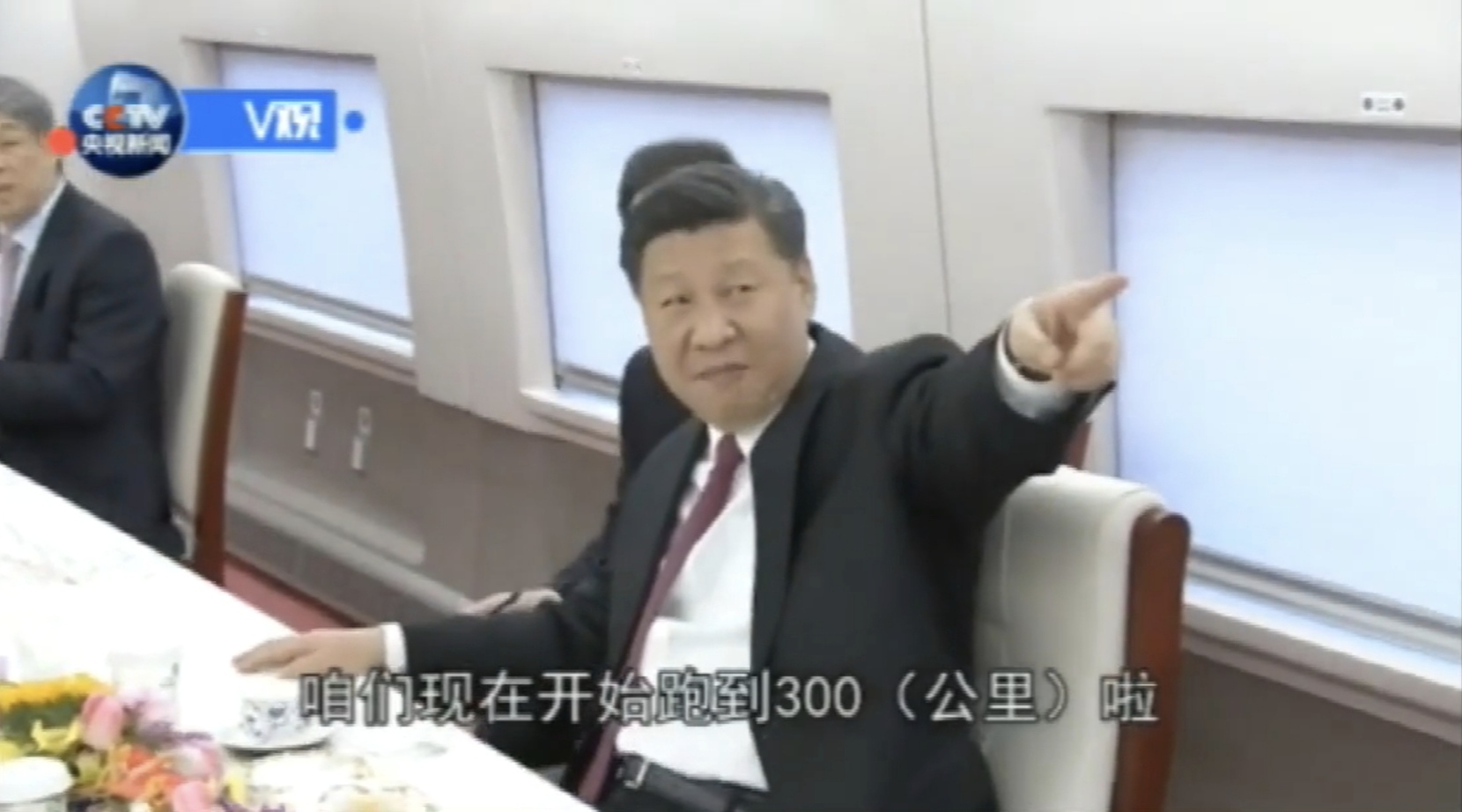
In China this is reserved for official government matters, so it would not be appropriate here.
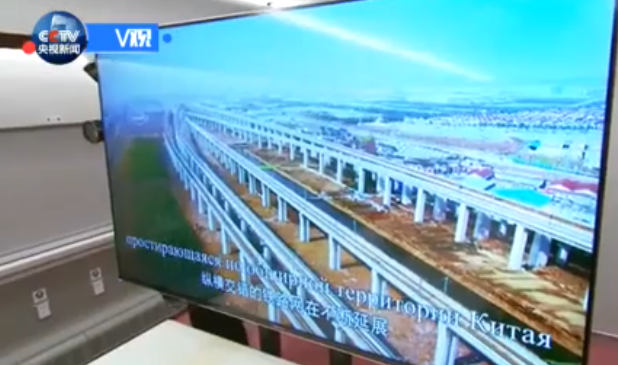
He is pointing at a TV.
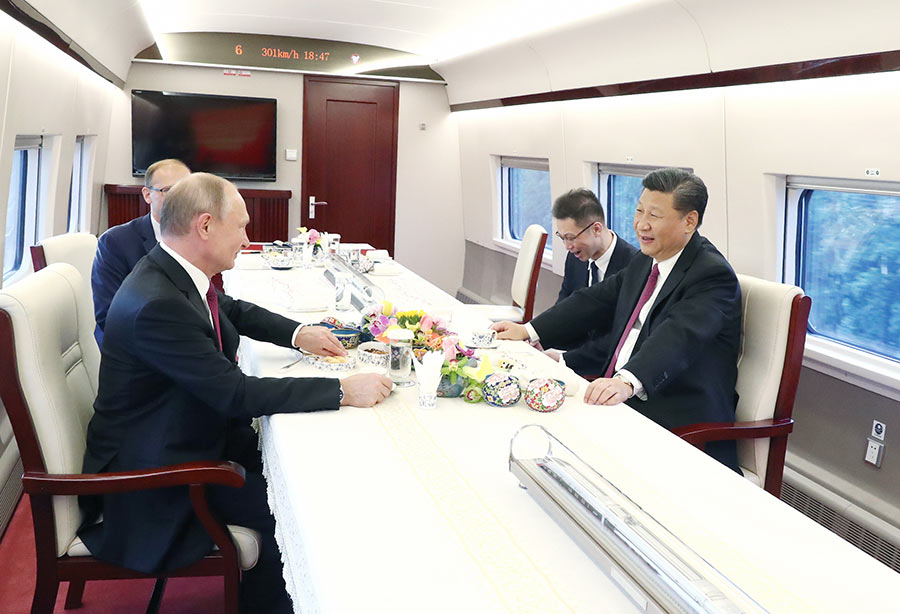
Xi Jinping and Putin taking the high-speed rail to Tianjin, China in 2018-06-08, during Putin’s visit.
Video: https://baijiahao.baidu.com/s?id=1602713068773632490
Putin’s China trip: High-speed train, ice hockey, local snacks https://www.chinadaily.com.cn/a/201806/09/WS5b1b6670a31001b82571f152.html
Banner suggestion: Tian’anmen Rostrum, from https://www.bjdch.gov.cn/mldc/bglj/whgj/202008/t20200827_2975729.html
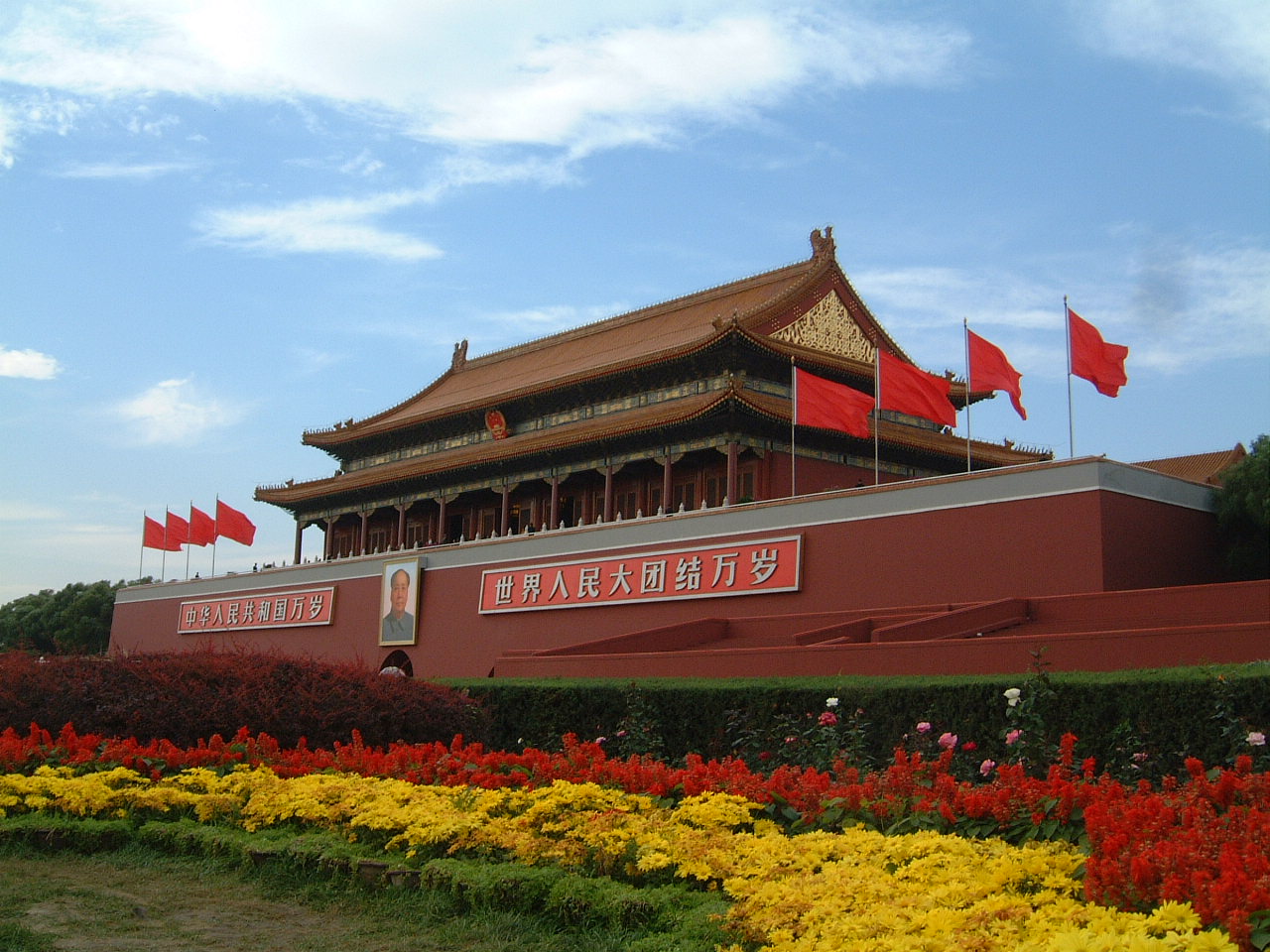
On the left is the slogan “中华人民共和国万岁” (Long live the People’s Republic of China), on the right is the slogan “世界人民大团结万岁” (Long live the great unity of the people of the world), in the middle is a portrait of Mao Zedong.
I recognized the title immediately because I have the following pinned on my Weibo profile in Chinese. From “The Governance of China II”: Let a Healthy Internet Guide and Reflect Public Opinion http://en.npc.gov.cn.cdurl.cn/2021-12/27/c_693855.htm
A society that lacks common ideals, goals, and values and that finds itself in disorder all the time will never achieve success.
Netizens are members of the general public. If members of the public go online, so does public opinion. Our officials need to go wherever the public goes, otherwise how else are they expected to maintain ties with them? Party and government organs and their leaders must learn to stay in touch with the people through the internet. They should go online regularly, observing, chatting, and posting their comments. They need to know what the people think and want, gather good ideas and suggestions, and actively respond to their concerns, answer their queries and remove their doubts.
The majority of netizens are ordinary people who come from different walks of life and have different life experiences. Their views and opinions are sure to vary greatly, and we cannot expect them to always be right about everything and correct in what they say. More tolerance and patience are therefore required. We need to promptly take constructive suggestions, afford assistance to those who need help, tell the truth to those in the dark, offer clarification to those who are confused about certain issues, help pacify those who bear a grudge against something, and guide those with erroneous views and correct their misunderstandings. This way we will ensure that the internet becomes a new platform through which we communicate and interact with the public, a new means through which we understand the people, stay in touch with them, and address their worries and difficulties, and a new channel through which we promote people’s democracy and accept public scrutiny.
A sound atmosphere for the expression of opinion online does not imply that there should be only one voice and one tune. Rather, it means that people are not permitted to conflate right and wrong, circulate rumors, cause trouble, violate the law, or commit crime; it means that people cannot overstep the boundaries of the Constitution and other laws.


About Google, they still have a (valid?) ICP license ICP证合字B2-20070004号 registered to their company in China 北京谷翔信息技术有限公司, and ICP record 京ICP备13004732号-2 for google.cn that was last reviewed in 2020.
The following are basically just the .cn mirror versions of the .com counterparts with some minor differences (like hints for links that may not be accessible in China).
https://developers.google.cn/ https://source.android.google.cn/ https://developer.android.google.cn/
Microsoft’s Bing (and other products) is legally operating in China at https://cn.bing.com (registered to 微软移动联新互联网服务有限公司), and they display the relevant licenses at the bottom of the page:
You can look up the ICP records of domains operating in China at https://beian.miit.gov.cn/, a handy service provided by the Ministry of Industry and Information Technology, either search by company name, domain name or ICP record.
As for why no American social media services are operating in China, they just can’t handle the regulatory burden of upholding socialist values.
Edit:
Just remembered that Microsoft’s Skype is still working in China, that counts for American social media… or at least American chat software. Discord is partially blocked (see my definition of “partially blocked” in my main comment here: https://lemmygrad.ml/comment/3886144) but I couldn’t get it to work without a VPN because they use WebSocket. Matrix works but matrix.org is partially blocked, so you’d have to use other non-blocked homeservers like genzedong.xyz.