

2·
9 days agoI’ve read it too, and this is a perfect summary. (The book is relatively long and the topic is complex, not an easy read.)
I’ve read it too, and this is a perfect summary. (The book is relatively long and the topic is complex, not an easy read.)

This is great fun, but maybe solar panels are too cheap for this now?
Concerning fun, check out the solar sinter project! (vimeo.com, 6min)

About marriage between cousins: Historically, the christian church has forbidden marriage between even very distant cousins. Intended or not, this has dismantled the power of large family clans.
Over centuries this has a clear effect on psychology: more individualism, a higher willingness to trust strangers (cooperation between non-relatives) and more. Joseph Henrich (anthropologist) has a whole book about this called The WEIRDest People in the World .

I’m using ublock origin to disable JS globally and re-enable it per-site from the popup. I didn’t realize it could do that until I read the manual.
Some sites break when you disable javascript, but guardian.com instead starts working.
Reminds me of the text-based role-playing heavy MUDs, where the players did their “pose” (a short paragraph describing what their character does) and you wait for 5 minutes while the other player(s) describe their move in return, often also adding a bit environment description. Some of the better player’s logfiles were basically prose you could almost publish. (Example: SpheresMUX)
Also, you got to like the name they came up with: it’s a MUSH (multi-user shared hullicination).

Uh, so far scientific predictions about the climate from even 20 years ago have been quite accurate, or a bit too optimistic. The scary predictions are for 50 to 200 years in the future and later. It’s just a very slow process (in human terms). Put CO2 into the atmosphere for a decade, not much happens. Put more CO2 in for another decade, it gets slightly warmer. Stop putting CO2 into the atmosphere, and the CO2 stays there for many hundred years, and the effects keep getting worse.
By the time you notice the bad stuff happening around you (desertification of farmland, floods, sea-level rise in coastal settlements), it’s too late to realize that you don’t have a technology to put the CO2 out again, and even if you did it would take another decade until you notice the effect.

Since you are already on Mastodon, I would start by checking out the instances of people you have interacted with. Many topic-instances are still pretty general-purpose. Decentralize yourself! Join two or three instances. Subscribe to different topics on each. See what sticks.
On a small instance, the local feed is much more important. Local users have a larger influence on what you discover. So, check the local feed first. It may be a bit boring but should be free of spam. Check the external feed. It should not be too tacky, and have a CW where you want one. Check the moderation policy. If you want to commit to only one small instance, find out who pays the hosting and maybe donate.
I love how you can pick almost any number between 1 and 100 and there will be instances in FediDB with exactly that many accounts. Long tail indeed.
In other news, “AI could consume more power than Bitcoin by the end of 2025” (digiconomist.net).
I mean yes, look at AI energy consumption. But wasting electricity by mining Bitcoin is so infinitely more stupid. Because you could do the same nonsense with money systems without wasting energy.
Not the person you asked, but my critique would be: It moves the focus away from decarbonization towards solving very obvious local short-term problems. A move to gain credibility/popularity in the public eye, instead of pushing for long-time measures that have a globally distributed effect. Aka “there is no glory in prevention”.
That said, I know it’s easy to critique like I did without being directly involved. Perhaps the idea is to then use this new political capital to push for those measures again. It may be a smart move, and it will certainly be a good thing to push for adaptation measures locally anyway, before everyone can finally agree that they are needed. But it does feel like giving up on the cost-effective but unpopular decarbonization.
This year my highlight was “Exhalation” by Ted Chiang.
It is a collection of (not so) short stories. I didn’t like every one, but those I liked were absolutely brilliant. The title story, “Exhalation”, was one of those. I wanted to read something by Ted Chiang specifically because I adore the movie “Arrival” (2016), and found out it was based on one of his stories (not in “Exhalation”).
Btw. I liked “Project Hail Mary” too, read it last year.

Regarding students cheating with ChatGPT, I liked this article from a professor, quote:
“Students are afraid to fail, and AI presents itself as a savior. But what we learn from history is that progress requires failure. It requires reflection.”
But when failing anything in class, students usually end up having fewer options, need to get better marks elsewhere to compensate, or get forced to repeat a year. So they use any tool or technique that might help them pass.

Do you remember the <blink> tag, or pages that wouldn’t work without a Java applet or Flash plugin? Good times ;-)
The article presents a few HTML features. (From the title I didn’t know what to expect.) Summary:
Ironically, the article showed a blank space where a graphic would go before I bothered to enable Javascript. On the plus side, it was readable regardless.
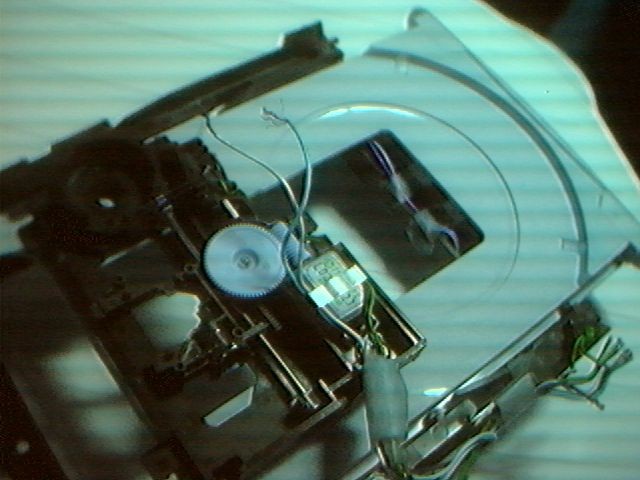
Picture from 2002. This was a 2D plotter made from the motors of a CD-ROM drive. The open wires connected to a copper coil that smashed a pencil up and down. A hard-disk magnet was glued to the pencil. 3D printing wasn’t a thing back then, otherwise I probably would have started a fire with an improvised heater on top of this.
Yes, IIRC Undertale it will only taunt you a bit at first, you have to play almost to the end before you really notice. But then it masterfully beats you against the 4th wall, hard, several times. (Speaking about eating the wrong cookies, yes it does feel like that.)
And then, when you start a second play-through, the 4th wall stays broken. (Personally I didn’t care enough for the game for a second play-through, but if you read it up it’s a whole thing, the game will not simply reset.)
Are we hardwired to want social status?
Yes. Like many animals, we primates have a psychology of dominance. It helps to prevent constant daily fights over everything, so a group can function. You defer to the strong leader, or else. And you try to become the leader to get the benefits.
Unlike other primates, we have a second social status called “prestige” which is used for cultural learning. So you should upvote this post, like and subscribe, give me some virtual prestige. I may not be able to beat up your leader, but I can write eloquent posts such as this one, get more back from the hunt than others (see all those feathers and bones I’m wearing?), and everyone knows that I weave those useful baskets you use daily. Do what I do, and maybe you’ll become just as capable and healthy as I am. Defer to me to get access to me, to watch and learn from me, to copy everything I do. Which books to read. Whom to to vote for. Eating one carrot a day. You never know which of those is the secret ingredient. Better just copy everything this healthy-looking human does and believes.
I don’t know the details, but there is this beautiful Great Britain grid status page, and you can see the transfers to Ireland for the past year. If I’m reading this right they installed an absurd amount of wind (not enough, but getting close) and Ireland is currently importing.

I may have created two accounts when I got here, and I will be baited into replying to snarky comments only from this one! I also like the low-key split-personality feeling, and experimenting with a different set of subscriptions. Anyway, so I’m no content-generation machine. But I’m doing my part to keep up the signal-to-noise ratio!