

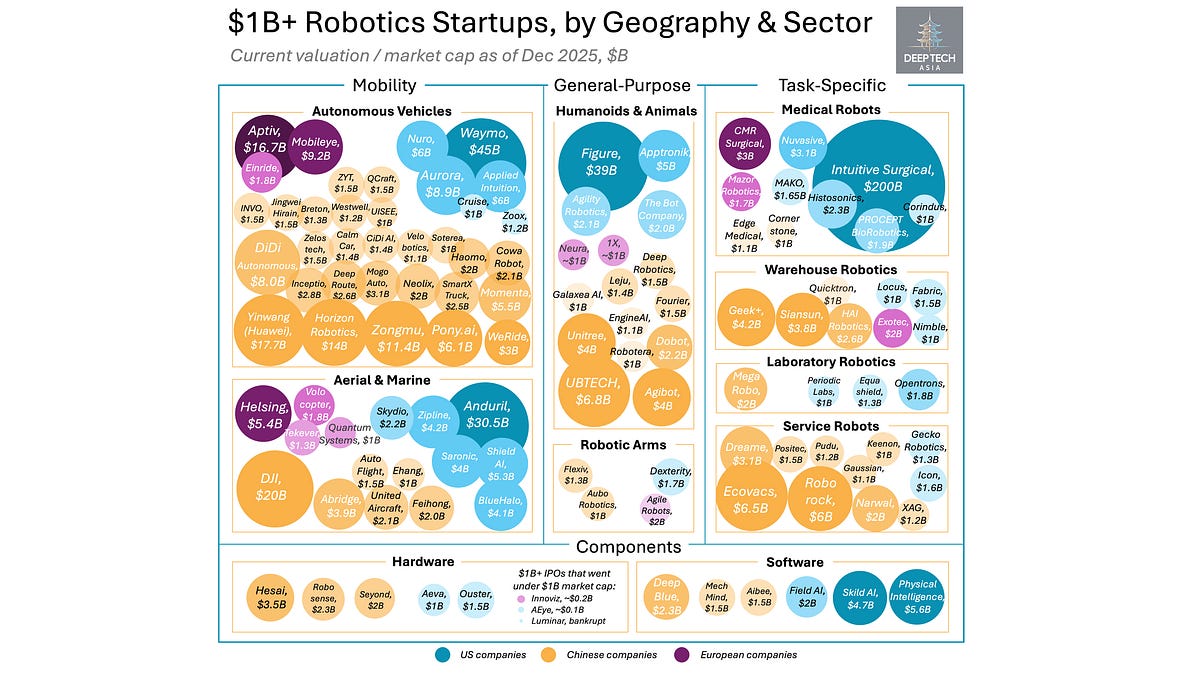
I’m always fascinated by how core fundamental economic facts and realities can’t sometimes have deep and profound manifestations. The link below talks about how this will likely be true for robotics over the coming decades.
The key insight here is scalability. Hardware businesses are less scalable than software because you need to procure components, produce and assemble them, and then move physical products across sophisticated supply chains to other parts of the world. Also, deploying robotic solutions at every facility requires high customisation and support from system integrators, which significantly limits scalability.
This means it’s unlikely we’ll get robotics companies that quickly become huge like Google or Meta. The end result? Robotics won’t be dominated by big players, but instead by many smaller/medium-sized enterprises spread out across the world. That has interesting implications. Many people wonder if taxing robotics firms may partially fund UBI, and having the firms smaller may make this easier.
I am a Small Business Person, take your monopolies & Capitalism stick where the sun do not shine!
Plus these Capitalist monopolies unemploy & endanger people!